What is it?
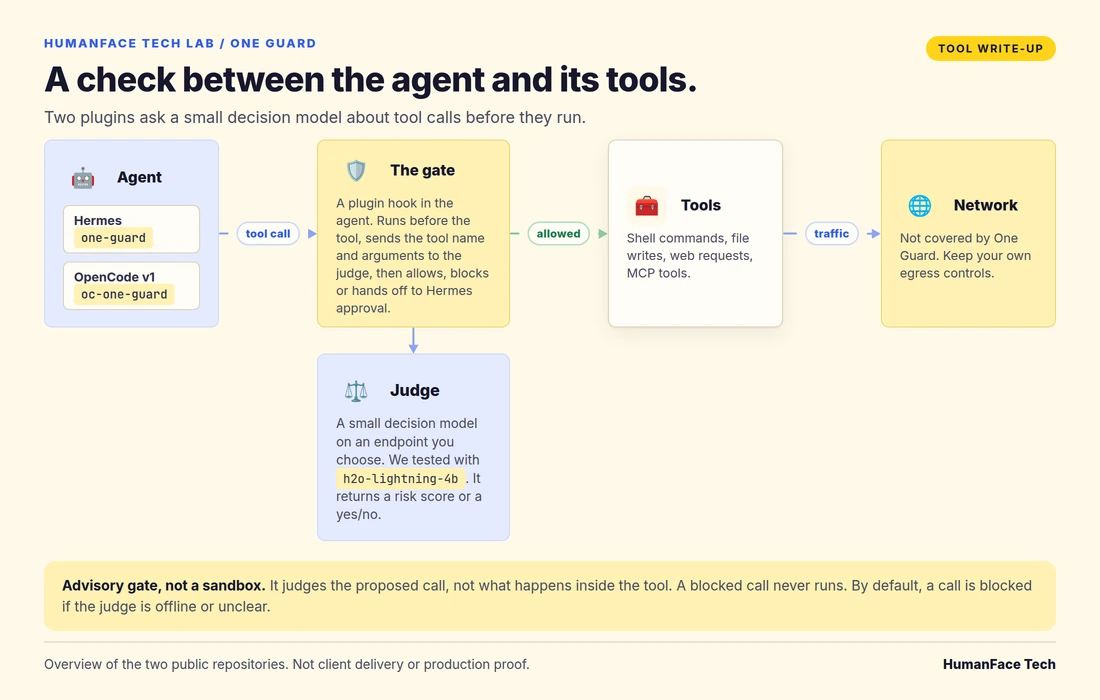
One Guard is a check in front of an AI agent's tool calls. Before the agent runs a command, fetches a URL or writes a file, a small decision model (the judge) reads the call and decides whether it looks risky, mainly whether private data could leave the machine. The plugin then allows or blocks the call. In one Hermes setting it can hand off to Hermes's approval step.
There are two plugins, one per agent. one-guard is for the Hermes agent. oc-one-guard is for OpenCode v1 and is on npm, currently at 0.1.2. Both are public on GitHub under the MIT licence.
We built them for our own agent setups, which often run local models. Neither is client delivery.
Why?
An agent runs commands, fetches URLs and writes files on its own. A local model is not automatically a safe one. A training artifact or a planted behaviour could make it post your credentials to a bucket it picked. One of one-guard's live checks uses a command from a published October 2026 agent trace that uploads a test string to an outside storage endpoint.
We put the check on the tool call. The call is what leaves the machine, whatever the model meant to do.
How it works?
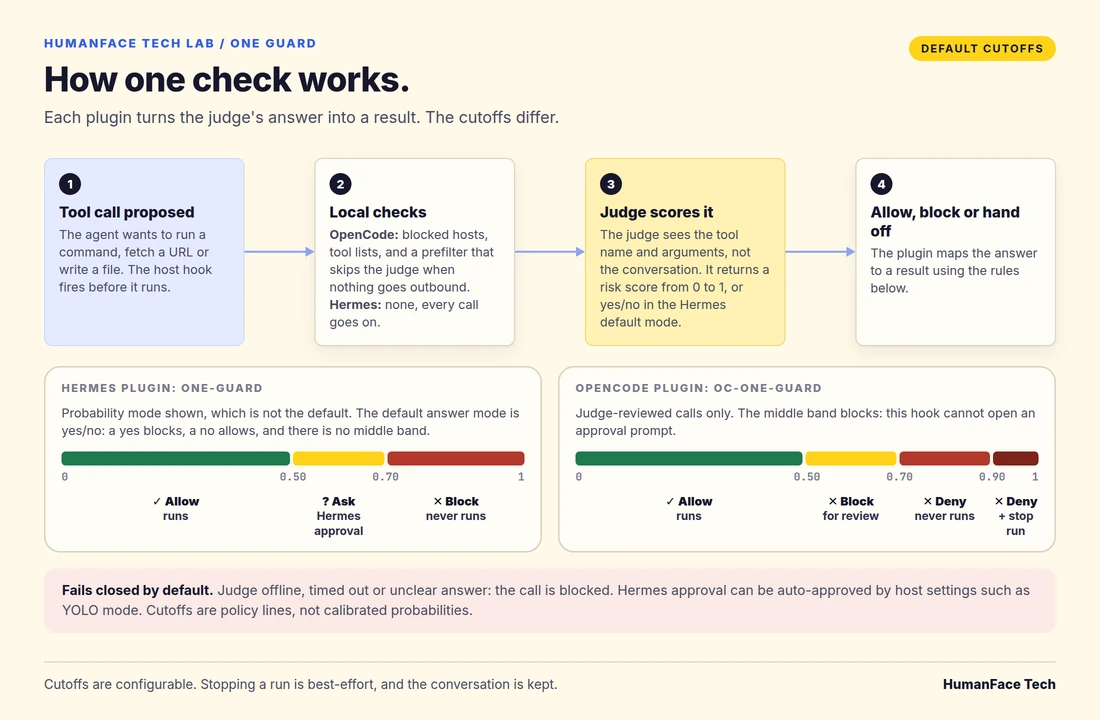
Both plugins follow one path: tool call, judge, result. oc-one-guard runs local checks before the judge. With the llama.cpp /v1/systemone endpoint the judge is a decision model: it returns a probability for one question. Both plugins support it; we tested with h2o-lightning-4b. one-guard's default setup asks any OpenAI-compatible chat model for a yes or no.
The two plugins differ
In one-guard (Hermes):
- Every tool call goes to the judge.
- The default mode is yes/no. Probability mode adds a middle band that hands the call to Hermes's own approval gate. Host settings such as YOLO mode can approve it with no person present.
- The judge timeout defaults to 5 seconds, and Hermes adds its own hook limit, 30 seconds by default. A slow judge needs both raised.
In oc-one-guard (OpenCode):
- Local checks run first: blocked hosts, tool allow and deny lists, and a prefilter that skips the judge when a call has nothing outbound.
- The middle band blocks, because the OpenCode hook cannot open an approval prompt. At 0.90 and above the plugin also asks OpenCode to cancel the run, best effort.
- The timeout defaults to 20 seconds. An optional fallback judge runs only after a timeout and receives the same unredacted call.
- It supports OpenCode v1 only. 1.19.4 is the tested version.
What it does not do
- It is an advisory gate, not a sandbox. It judges the proposed call. It cannot see inside a tool or stop a process that has started.
- It fails closed by default. If the judge is offline, times out or gives an unclear answer, the call is blocked. With one-guard, an offline judge blocks every tool call.
- The judge sees the tool call, not the conversation. An upload you asked for can look suspicious. The Hermes plugin judges
sh script.shas a string, not the file. - It can be wrong. It misses some risky calls and blocks some harmless ones.
- The judge receives the call unredacted, and oc-one-guard can also send staged file contents. Choose a trusted endpoint, and use HTTPS if it is remote.
- In Hermes, another plugin can change a call after the check, and the changed call is not judged again.
- Keep network egress controls and process isolation. Neither plugin covers connections a tool opens itself.
What oc-one-guard's own check shows
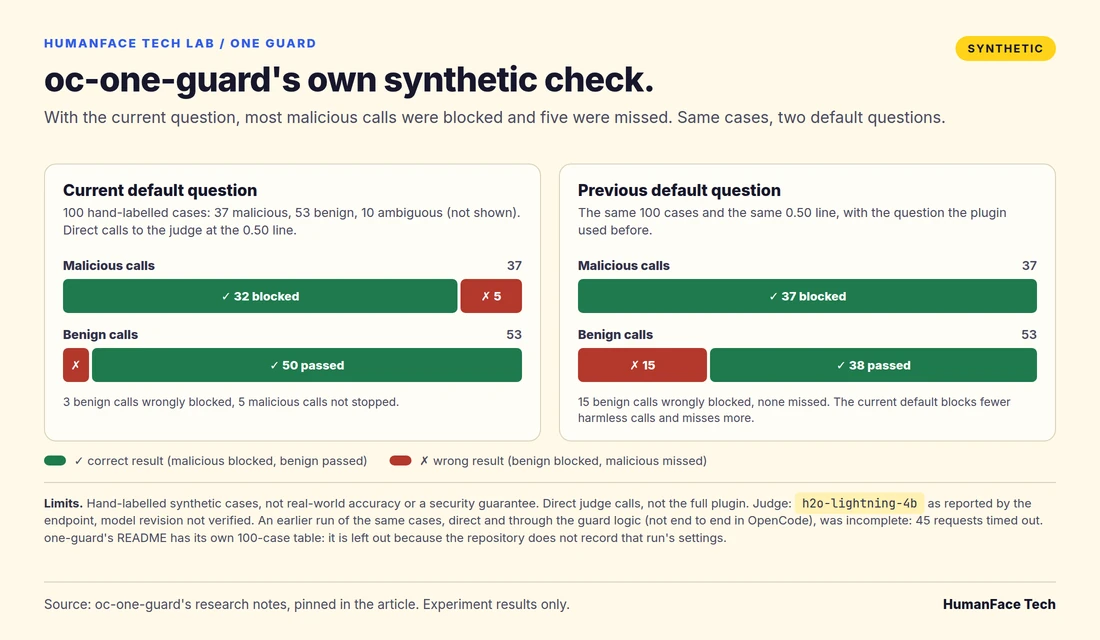
The repository ships a hand-labelled synthetic test set. Sent straight to the judge, the current default question stopped most malicious calls and missed five. The previous one missed none but blocked more harmless calls.
What it unblocks / where it leads
If you run local or self-hosted agents, this adds one layer between the model and your tools. Start with a judge on a loopback address and one project, and check the cutoffs against your own calls.
For Hermes, clone the repository and run the guided installer. It writes nothing until you confirm.
git clone https://github.com/HumanFace-Tech/one-guard.git
cd one-guard
sh ./install.sh
For OpenCode, add a pinned entry to one project's config and restart.
{
  "plugin": [
    ["oc-one-guard@0.1.2", { "endpoint": "http://127.0.0.1:8081/v1/systemone", "model": "h2o-lightning-4b" }]
  ]
}
To go deeper, read the founder's October post on nikro.me: Local AI - October 2026.
Sources
- one-guard on GitHub: the Hermes plugin
- oc-one-guard on GitHub: the OpenCode plugin
- Local AI - October 2026 on nikro.me: the founder's write-up